Turn Facebook Comments and DMs Into Intelligent Conversations
Noor Hussain·October 6, 2026
BotLance connects Facebook comments, private messages, AI, business knowledge, workflows, and human support so every customer interaction can become part of one continuous conversation.
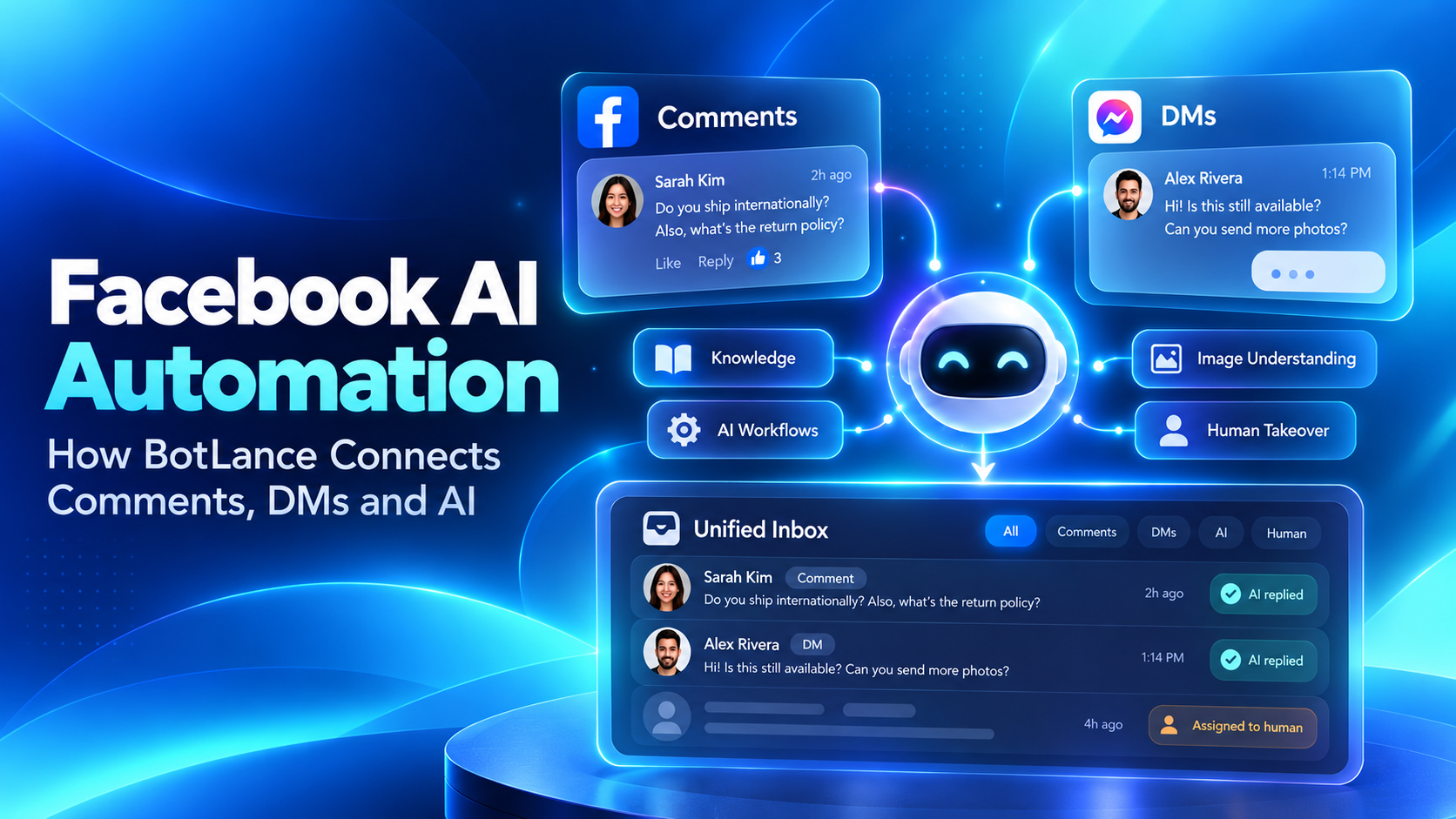
Facebook AI Automation in 2026: How BotLance Connects Comments, DMs and AI
Facebook remains one of the most important places for businesses to communicate with customers. A potential customer may discover a business through a post, ask a question in the comments, send a private message a few minutes later, return another day with a different question, or eventually need help from a real person. The challenge is not simply responding faster. It is keeping those interactions connected so the customer does not feel as though they are starting from zero every time they move between a comment and a private conversation.
BotLance is designed around that idea. Instead of treating Facebook comments, DMs, AI responses, workflows, and human support as separate systems, it brings them together into one customer conversation. Businesses can automate predictable journeys with workflows, allow AI to answer open-ended questions using real business knowledge, manage comments and private messages from the BotLance Inbox, and step in manually whenever a human response is needed.
AI That Works Across Facebook Comments and DMs
Facebook automation is often associated with simple triggers: someone uses a keyword, an automation runs, and a predefined message is sent. That remains useful, especially for campaigns where the next step is known in advance. But customers rarely communicate exactly the way a workflow designer expects.
Someone might comment “PRICE” because a post specifically asked them to. Another person may write, “How much does this service cost?” A third may simply ask, “Are you open on Sunday?” These are different interactions and should not necessarily be handled by the same fixed reply.
BotLance combines workflows with a default AI agent. If a configured keyword or workflow condition matches, the appropriate automation can run. If no workflow applies, the AI agent can still understand the customer's question and respond using the business instructions and Knowledge Base available to it.
This means a company does not have to create a separate keyword for every question a customer might possibly ask. Structured automation handles predictable customer journeys, while AI handles the conversations that require actual understanding.
Facebook Comments Can Be Real Conversations
A Facebook comment does not always need to be treated as a one-time trigger.
A customer might ask, “What is the price?” and then follow up with, “Where are you located?” or “Is this available next week?” BotLance can allow that interaction to continue as an AI-powered comment conversation rather than forcing every customer immediately into DMs.
The AI can use available business knowledge when answering those questions, which makes comment automation more useful than simply choosing between several predefined variations of the same reply.
Businesses still have control. If a particular campaign should send the customer into a private message workflow, BotLance can do that. If the better experience is to answer publicly beneath the Facebook post, the conversation can remain there.
The automation strategy follows the business objective rather than forcing every Facebook interaction through exactly the same path.
Comments and DMs Stay Connected to the Same Customer
One of the most valuable parts of the BotLance Facebook experience is continuity.
Imagine someone first sends the business a private Facebook message. They ask several questions about a service, and the AI answers them using the company's knowledge. Later, the same person sees a Facebook post and leaves another question in the comments.
BotLance does not need to behave as though an entirely new person has appeared.
The interaction can remain connected to the same customer context, allowing the AI to continue with awareness of the existing conversation instead of unnecessarily restarting from the beginning. The same principle applies when the journey begins in the comments and later moves into a private message.
This becomes particularly important for sales and support conversations that happen over several interactions. A customer may not make a decision in one message. They may return later, ask something publicly, continue privately, and eventually speak with a human. Maintaining that continuity makes the AI experience feel significantly more natural.
One Inbox for Facebook Comments and Private Messages
Connecting the conversation is useful only if the business can clearly understand what is happening.
BotLance brings Facebook interactions into its Inbox while preserving the context of where each interaction came from. The business can distinguish a public comment from a private message instead of seeing an ambiguous stream of customer activity.
This also changes what the team can do from the Inbox.
If a Facebook comment appears in BotLance and a team member wants to answer personally, they can reply directly from the BotLance Inbox. Because the interaction originated as a Facebook comment, the response is sent back as a reply beneath that comment.
If the customer interaction is a private Facebook message, replying from the same Inbox sends the response back privately instead.
That means the team can manage both public and private Facebook conversations through one interface without losing the distinction between them.
A unified inbox should not mean turning every interaction into the same type of message. BotLance keeps the conversation centralized while still routing each response to the correct Facebook surface.
Business Knowledge Makes the AI More Useful
A useful Facebook AI agent needs more than the ability to generate natural-sounding sentences.
Customers ask questions that depend on real business information: prices, services, locations, availability, products, processes, policies, appointments, and countless details that a generic AI model could not reliably know on its own.
BotLance connects its AI agent with the business Knowledge Base so Facebook conversations can use information the business has actually provided. This gives the AI context for answering relevant customer questions instead of relying only on a short prompt or generic assumptions.
The same knowledge can support different types of conversations. A question may arrive as a private message today and as a comment tomorrow, but the underlying business information does not need to be recreated separately for every automation.
That creates a more manageable system, particularly for businesses with a large number of services, products, locations, or frequently asked questions.
Workflows Handle the Journeys You Want to Control
AI is valuable, but not every business process should be left open-ended.
If a Facebook campaign asks people to comment a particular keyword, the business may want a very specific sequence to happen afterward. It might send a private message, collect information, qualify the customer, perform an action, or move the conversation through additional workflow steps.
BotLance allows businesses to build these structured journeys while keeping the AI layer available for conversations that fall outside them.
A workflow can therefore handle the predictable part of the customer journey without making the entire Facebook experience rigid. When a person asks something unrelated to the configured workflow, the default AI agent can still handle the question instead of reaching a dead end.
This combination of workflows and AI is particularly useful because it gives businesses both control and flexibility.
Facebook Conversations Are Not Always Text-Only
Customers communicate in different ways. Some type a question. Others send an image because it is easier to show what they mean. Some people prefer voice messages to typing long explanations.
BotLance's AI capabilities are designed to work with more than plain text. Images can become part of the AI conversation, allowing the system to understand supported visual input instead of ignoring an important part of the customer's message. Voice messages can also be processed so customers can communicate more naturally rather than being forced to convert everything into text first.
This is especially useful for customer-facing businesses where context is often visual or difficult to explain in a short written message.
AI becomes much more practical when customers can communicate the way they already communicate with real people.
Human Takeover Without Fighting the AI
There will always be conversations that should involve a human.
A customer may explicitly ask to speak to someone. A lead may reach an important stage. A support issue may become sensitive, or a team member may simply decide that personal attention would produce a better outcome.
BotLance includes human takeover and AI pause behavior so the automation does not continue speaking while a team member is handling the conversation.
This is essential for creating a good customer experience. AI should reduce repetitive work, not make it difficult for a real person to step into a conversation.
The BotLance Inbox gives the team a central place to manage these interactions while keeping the customer's previous conversation available for context.
From a Facebook Comment to a Business Action
The most valuable Facebook conversations often lead somewhere.
A customer asking about availability may want an appointment. Someone interested in a service may become a lead. Another person may need to provide information. A conversation may need to trigger a workflow or communicate with another business system.
BotLance is designed so the AI experience can connect with workflows, actions, integrations, APIs, and other business processes rather than ending after a text response.
This makes Facebook more than another messaging channel inside the platform. A conversation that begins beneath a post can become part of a larger customer journey while still maintaining its context along the way.
A More Connected Approach to Facebook Automation
The real value of Facebook AI automation is not measured by how many messages a business can automatically send. It is measured by how naturally automation can fit into real customer conversations.
Customers move between comments and private messages. They ask unexpected questions. They return later. They send images and voice messages. Sometimes they need a structured workflow, and sometimes they simply want an intelligent answer. Eventually, some conversations need a real person.
BotLance brings those pieces together.
Facebook comments and DMs can share customer context. AI can use business knowledge. Workflows can handle predictable journeys. Comments can be answered directly from the BotLance Inbox. Private messages can be managed from the same place. Media can become part of the AI conversation, and humans can step in when necessary.
The result is not simply automated Facebook messaging. It is a connected Facebook customer experience built around AI, automation, and human control.