
Why AI Agents Are Becoming Essential for Businesses in 2026
Noor Hussain·August 29, 2026
AI has moved beyond answering questions. In 2026, businesses are using AI agents to understand customers, connect systems, execute workflows, and get real work done.
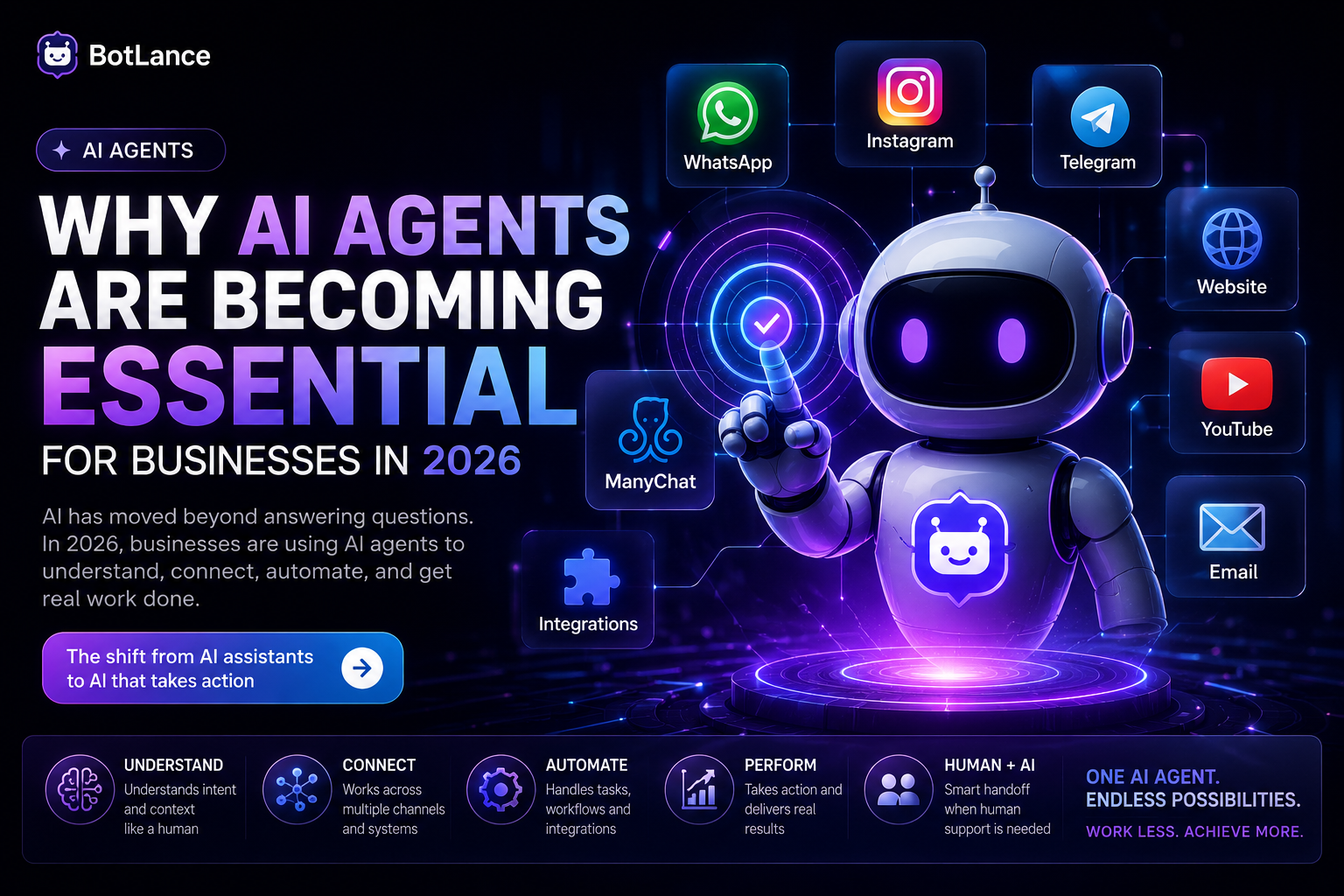
Why AI Agents Are Becoming Essential for Businesses in 2026
AI has changed quickly over the past few years. What started as a powerful way to generate text, answer questions, and summarize information has become something much more useful for businesses: AI that can actually take action.
That is where AI agents come in.
In 2026, the conversation around artificial intelligence is no longer simply about whether a business should have a chatbot. Businesses are asking a much more important question: can AI actually help run part of the work?
An AI agent can understand a customer's request, use information from connected systems, decide what needs to happen next, call the appropriate tools or APIs, complete multiple steps, and return the result to the customer or the business.
That changes the role of AI completely.
A traditional chatbot might tell a customer how to book an appointment. An AI agent can potentially check availability, schedule the appointment, update the relevant system, and confirm the booking. A chatbot might explain a product. An agent can answer the question, collect the customer's information, qualify the lead, and trigger the next step in the sales process.
The difference is simple: a chatbot mainly talks. An AI agent can work.
The shift from answers to actions
This is one of the biggest changes happening in AI in 2026.
For years, businesses focused on using AI to generate information. Today, businesses are increasingly interested in delegating work to AI.
Google Cloud's 2026 AI Agent Trends research describes this transition as a move from individual tasks and prompts toward systems capable of orchestrating complex, end-to-end workflows. OpenAI has similarly described agentic AI as a shift from short interactions toward longer-running tasks in which agents can use tools, interact with environments, and work toward a goal with less continuous human intervention.
That distinction matters.
If an AI system only produces an answer, someone still has to do something with that answer.
If an AI agent can safely execute the next step, the AI becomes part of the workflow itself.
This is why businesses are increasingly looking at AI agents not simply as another customer-service feature, but as a new layer of business automation.
Customers don't want to talk to a chatbot. They want their problem solved.
This may be one of the most important lessons for businesses adopting AI.
Customers generally don't care which AI model is behind a conversation. They care whether their problem gets solved quickly and accurately.
If someone wants to know an opening time, an answer is enough.
If someone wants to change an appointment, they expect the appointment to actually be changed.
If someone wants to buy something, they may need product information, availability, pricing, and a way to continue the purchase.
If someone wants to speak to a person, the system should make that possible without forcing them through an endless automated conversation.
This is why the next generation of customer-facing AI is moving beyond simple question-and-answer experiences.
Gartner's 2026 research shows just how significant this shift has become. Customer-service organizations are increasing their AI spending rapidly, while agentic AI platforms and generative AI customer-service technologies are expected to deliver substantial future value.
At the same time, Gartner reports that customers still strongly value access to human support when AI is involved. In a 2026 survey, 87% of customers said companies using generative AI for customer service should provide access to a human agent.
The lesson is not that AI should replace humans.
It is that AI should make the entire customer experience better.
AI agents can connect the systems businesses already use
Most businesses don't run on one application.
A company might have a website, CRM, calendar, email platform, social-media accounts, messaging channels, spreadsheets, payment systems, marketing tools, and internal workflows.
Each tool might work perfectly well on its own.
The problem is what happens between them.
A lead arrives through Instagram. Someone has to capture it.
A customer asks for an appointment on WhatsApp. Someone has to check the calendar.
A customer submits information through a website. Someone may need to enter it into another system.
A conversation needs human attention. Someone needs to notice it and hand it over.
These repetitive connections are exactly where AI agents become interesting.
Instead of treating every application as an isolated system, an AI agent can sit between them and use integrations, APIs, and business tools to perform the appropriate actions.
That means the AI isn't replacing the software businesses already use.
It is making that software more intelligent.
One AI system can work across multiple channels
Customers don't think in terms of your software stack.
They simply use whatever communication channel is convenient.
One person might visit your website.
Another might message you on Instagram.
Another might use WhatsApp.
Another might contact you through Messenger.
Another might communicate through email.
From the customer's perspective, these are simply different ways of reaching the same business.
That creates another important opportunity for AI agents.
Instead of building completely separate intelligence for every channel, businesses can connect their customer-facing channels to a common AI system and allow that system to understand conversations, access relevant information, and perform actions across the connected environment.
The channel becomes the interface.
The AI becomes the intelligence behind it.
AI agents are becoming workflow engines
The most powerful use cases often aren't individual conversations at all.
They are workflows.
Consider a simple lead-generation process.
A potential customer sends a message.
The AI understands what they are looking for and answers their initial question. It then asks the relevant qualification questions, captures the lead information, stores it in the appropriate system, and offers the customer the next step.
If the customer wants an appointment, the workflow can continue into scheduling.
If the customer needs a human, the conversation can be handed over.
If the customer returns later, the business can already have the relevant context.
What previously required several tools and manual steps can increasingly be connected into one intelligent process.
This is the real promise of agentic AI.
It is not simply about making conversations more natural.
It is about turning conversations into completed work.
Why 2026 is different
AI agents are not entirely new. Businesses were already experimenting with them in previous years.
What has changed is the maturity of the technology and the expectations surrounding it.
In 2026, businesses are increasingly moving from experimentation toward production.
LangChain's 2026 State of Agent Engineering report found that 57% of surveyed professionals had agents in production, while observability had become a major part of how organizations operate those systems.
Salesforce also reported a significant increase in customer-service organizations using AI agents, with adoption rising from 39% in 2025 to 66% in 2026 among the organizations surveyed.
At the same time, the industry is becoming more realistic about what it takes to deploy agents successfully.
Businesses need reliable integrations.
They need permissions.
They need monitoring.
They need guardrails.
They need human escalation.
And they need to know exactly what an AI agent is allowed to do.
The future of AI agents isn't simply about making them more autonomous.
It is about making them useful, reliable, observable, and safe enough to operate inside real businesses.
The best AI agent is not necessarily the most autonomous one
There is a temptation to think that the ultimate AI agent should operate completely independently.
In practice, that isn't always what businesses need.
A good AI system should know where it has authority and where it doesn't.
It might be perfectly appropriate for an agent to answer a product question or qualify a lead automatically.
A financial transaction, sensitive customer request, or unusual business decision may require approval.
A customer who specifically asks for a human should be able to reach one.
The goal should therefore be controlled autonomy rather than blind autonomy.
AI handles what it is good at.
People remain involved where their judgment matters.
That combination can be far more valuable than trying to automate everything.
The real business advantage is consolidation
There is another reason AI agents are becoming increasingly important: businesses are tired of managing disconnected tools.
A business may already be paying for a chatbot, an automation platform, a CRM, a messaging platform, a scheduling system, and several other services just to move information from one place to another.
The more systems a business uses, the more complicated the overall workflow becomes.
AI agents introduce a different possibility.
Instead of thinking about AI as yet another isolated application, businesses can use it as an intelligence layer that works with the tools they already have.
The AI can communicate with those systems through integrations and APIs while the business keeps using the platforms it already depends on.
That is a much more practical approach to AI adoption.
Businesses don't necessarily need to replace everything.
They need their systems to work together.
AI agents are becoming part of the business, not just a feature
This is perhaps the biggest change of all.
A chatbot used to be something you placed on a website.
An AI agent can become part of the operation behind the website, social channels, messaging platforms, workflows, customer support, lead generation, and internal processes.
That makes AI fundamentally different from another software feature.
It can become a layer that understands what is happening and helps decide what should happen next.
And as agents become better at using tools and completing longer tasks, that role will continue to expand.
What businesses should do next
Businesses don't need to automate their entire operation overnight.
A better approach is to start with one workflow that is repetitive, valuable, and clearly defined.
Look for tasks such as answering common customer questions, qualifying leads, booking appointments, collecting information, routing conversations, summarizing customer interactions, or triggering actions in another system.
Then connect the AI to the information and tools it actually needs.
Define what the agent can do.
Define what requires human approval.
Measure the results.
And expand from there.
The businesses that get the most value from AI agents won't necessarily be those that give AI the most control.
They will be the ones that give AI the right work to do.
The future is not another chatbot
The AI industry has spent years teaching computers to talk like humans.
Now the more interesting challenge is teaching AI to work like a useful member of the business.
That means understanding context, using tools, connecting systems, executing workflows, knowing when to ask for help, and ultimately helping customers reach an outcome.
That is why AI agents matter in 2026.
They represent a shift from AI that simply responds to AI that participates.
And for businesses, that shift can mean fewer repetitive tasks, faster customer experiences, better-connected systems, and more time for people to focus on work that actually requires them.
The chatbot was the beginning.
The AI agent is where the real workflow starts.