
Voice AI That Goes Beyond Phone Calls
Noor Hussain·October 18, 2026
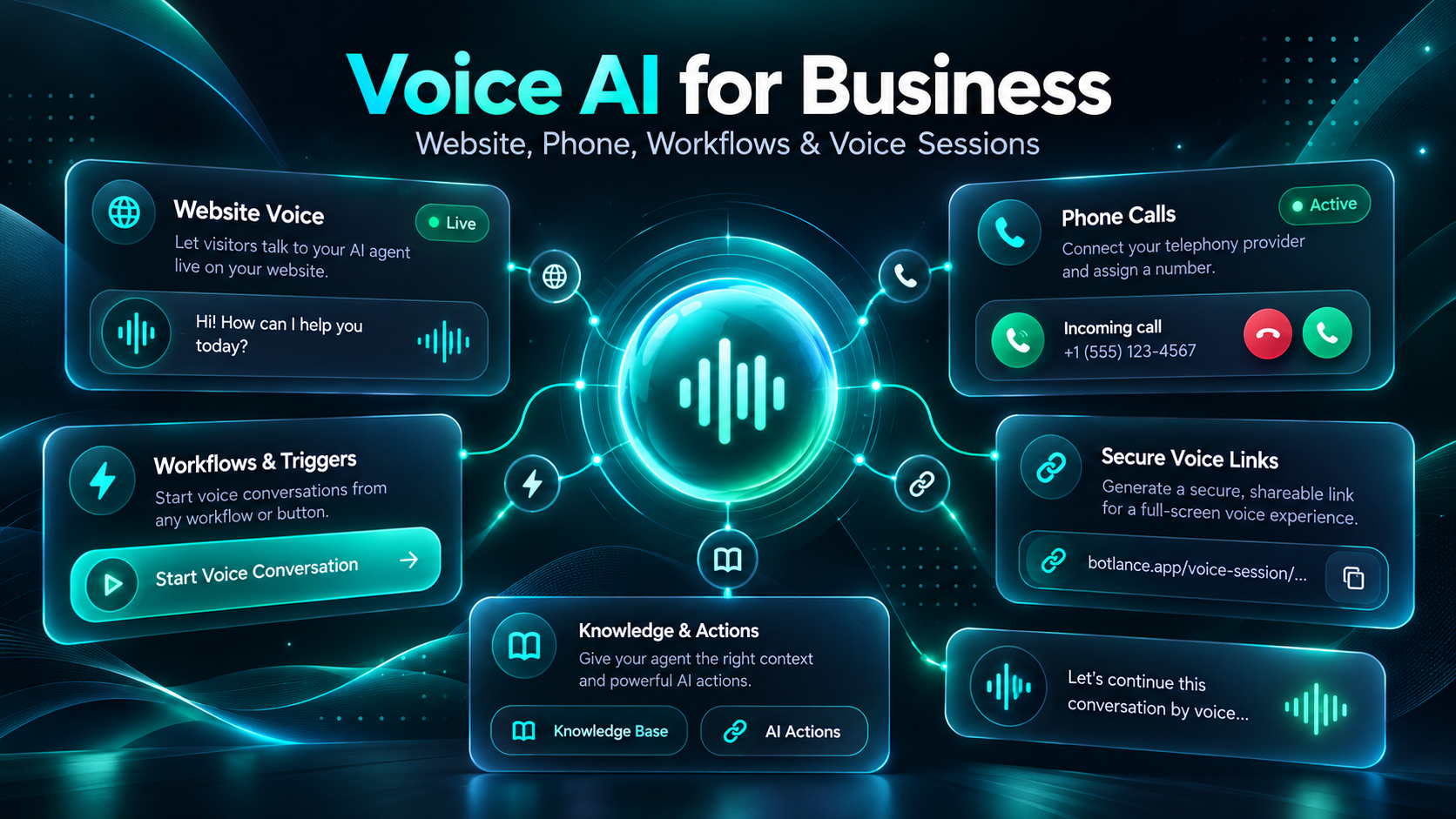
BotLance brings voice into websites, phone calls, workflows, customer conversations, and business actions so one AI agent can work wherever the customer needs it.
Voice AI Is Becoming Part of the Customer Journey
A useful voice agent should do more than answer a phone call.
Voice AI is often described as a replacement for traditional phone menus or basic call automation, but that view is becoming too narrow. A real customer journey rarely begins and ends with a single phone call. Someone may first ask a question on a website, continue the conversation through a social channel, receive an automated workflow message, and only then decide that speaking would be easier.
That is the problem BotLance Voice AI is designed around.
Instead of treating voice as a completely separate product, BotLance brings it into the same environment as AI conversations, Knowledge Base content, workflows, customer context, and AI Actions. The same voice agent can be used across different surfaces without rebuilding the business logic every time.
For a business, that means voice can become another natural way for customers to communicate rather than an isolated system sitting beside the rest of the automation stack.
One Voice Agent, Multiple Ways to Talk
The same agent can be available through the website, phone, secure links, workflows, and external systems.
Different customers prefer different ways to communicate, so a voice experience should not be limited to a single entry point.
BotLance allows one configured voice agent to be used across several surfaces. A visitor can start a live voice conversation directly from the website. A business can connect the agent to a phone number for traditional calls. A secure shareable voice link can be generated and sent to a customer. Workflows and AI Actions can create voice sessions dynamically, while external applications can start sessions through the Voice Session API.
The important part is that these are not separate agents that must each be configured from the beginning. The core voice agent keeps its instructions, knowledge, actions, language, voice settings, and operating rules across the supported deployment surfaces.
This makes the architecture easier to manage. The business defines how the agent should behave once, then decides where that agent should be available.
Turn a Website Conversation Into Live Voice
Customers can move from typing to speaking without leaving the website experience.
There are moments when text is the easiest way to communicate, and there are moments when speaking is simply faster.
BotLance can bring live voice directly into the website experience. A visitor using the website chatbot can move into a voice conversation instead of being sent to an unrelated application or asked to make a separate phone call.
That transition matters because the customer is already engaged with the business. They may have asked several questions, explained what they need, or provided information before deciding that speaking would be more convenient.
Rather than forcing the customer to begin again somewhere else, voice can become the next step in the same experience.
For businesses using AI on their website for enquiries, support, qualification, or appointments, this creates a more natural path from quick text questions to deeper conversations.
Voice and Text Can Work Together in the Same Session
Customers can speak naturally while typing details that need to be exact.
Speech is convenient, but it is not always the best way to provide precise information.
Email addresses are a good example. A customer may say an address correctly while a speech system interprets one character incorrectly. The same problem can happen with phone numbers, reference numbers, unusual names, codes, or other information where a single mistake matters.
BotLance allows text input during a live voice session.
This creates a hybrid experience where the customer can continue speaking naturally while typing information that needs exact spelling or formatting. The voice conversation does not need to stop, and the customer does not need to switch to another channel just to provide one accurate detail.
It may sound like a small feature, but it solves a very practical problem. Good voice AI should not force speech into situations where typing is clearly more reliable. It should allow both methods to work together.
The Voice Agent Can Use Your Business Knowledge
The agent does not need to rely on a generic prompt alone.
A natural voice is useful, but a business voice agent also needs accurate information.
Inside BotLance, a voice agent can be connected to the existing Knowledge Base. This allows the business to decide what information the agent is allowed to use during conversations, instead of expecting it to answer everything from general model knowledge.
The same Knowledge Base environment can contain information such as FAQs, business policies, service information, documents, website content, and other approved knowledge sources.
This becomes especially important when customers ask specific questions. A voice agent representing a clinic, agency, retailer, education provider, property business, or service company needs to understand the information of that business, not simply produce a polished-sounding response.
By reusing the existing BotLance Knowledge Base, businesses can keep their AI information centralized while making it available to voice where appropriate.
Voice AI Can Take Real Business Actions
A conversation becomes more useful when the agent can do something with the customer's request.
The value of a voice AI agent should not end when it finishes speaking.
If a customer wants an appointment, the ideal result may be to begin a booking process. If the customer is interested in a service, the business may want to capture lead information. If a situation requires a person, the agent may need to hand the conversation to a human. Other businesses may need custom actions connected to their own systems.
BotLance allows voice agents to use AI Actions alongside the Knowledge Base.
This means the voice agent can participate in the same broader business automation environment rather than operating as a standalone conversational demo.
The distinction is important. An AI that can only answer questions is useful. An AI that can understand the request and connect it to the next business step can become part of the actual customer operation.
Move an Existing Customer Conversation Into Voice
A customer should not have to repeat everything simply because the conversation changes format.
One of the most frustrating customer experiences is having to explain the same situation again every time the channel changes.
A customer may already have been talking with an AI agent through a website or another supported customer channel. The system may already know who they are, what they asked, and what they are trying to accomplish. If the conversation then moves into voice, that context should not automatically disappear.
BotLance can create a secure voice session while passing relevant conversation context to the selected voice agent.
The customer can receive a message containing a temporary voice link and continue the conversation by speaking. The voice agent can begin with useful context from the existing interaction rather than asking the customer to start over.
This is one of the areas where voice becomes much more powerful. It is no longer a separate destination. It becomes another stage of the same customer journey.
Start Voice Conversations From AI Actions
An AI agent can decide when moving from text to voice would create a better experience.
Sometimes the best next step in a conversation is not another text response.
BotLance includes a Start Voice Conversation action that can be assigned to an AI experience. When the action is used, the system creates a secure voice session for the selected voice agent and sends the customer a link through the current conversation.
The business can control whether customer context is included and define the message the customer receives with the link. The session can also have its own expiry and usage limits.
This allows voice to become an available action inside a larger AI conversation.
For example, a customer might be discussing a complex requirement through text and ask to speak instead. Rather than giving them a phone number and asking them to begin a completely new interaction, the AI can provide a direct path into a voice session connected to the conversation already taking place.
Voice Can Be Built Into Workflows Too
Structured automation can move a customer into a voice session when the journey calls for it.
Not every transition to voice needs to be decided dynamically by an AI agent. Sometimes the business already knows exactly where voice belongs in the customer journey.
BotLance workflows can use a Start Voice Conversation option on supported buttons and steps. When a customer selects that option, BotLance can generate the voice session using the existing Voice AI configuration and continue the workflow according to the business design.
This creates interesting possibilities for campaigns and customer journeys. A workflow may begin with a simple message, provide information, collect an initial response, and then offer the customer a button to continue through voice when the conversation reaches a stage where speaking is more appropriate.
The customer gets a straightforward experience while the business keeps the logic inside the same workflow environment.
Voice therefore does not have to replace workflow automation. It can become one of the experiences the workflow can offer.
Phone Calls Still Matter
The same voice intelligence can also be available through a real phone number.
Web voice sessions and secure links are useful, but conventional phone calls remain important for many businesses.
BotLance allows a voice agent to be connected to telephony so customers can speak with the AI through a normal phone call. This is especially useful for businesses where customers naturally expect to call, such as clinics, service providers, sales teams, local businesses, appointment-based companies, and customer support operations.
The telephony layer is only one deployment surface, however.
The important architectural difference is that the phone agent does not have to exist as a completely separate intelligence system. It can use the same Voice AI configuration, knowledge, actions, and business rules used elsewhere.
That makes it easier for a company to provide a more consistent experience regardless of whether the customer speaks through a browser or calls a phone number.
Voice AI Can Connect to External Systems
Developers and automation teams can create secure voice sessions programmatically.
Some businesses already have their own CRM, customer portal, automation system, or internal application. In those cases, voice should not be limited to experiences created manually inside the BotLance interface.
BotLance includes an external Voice Session API that allows authorized systems to create secure voice sessions programmatically.
This gives developers and automation teams a way to bring BotLance Voice AI into their own customer journeys. An external system can create a session for a selected voice agent, pass relevant customer information, and use the returned session details to send the user into the voice experience.
This makes Voice AI useful beyond the BotLance dashboard itself.
A business can keep its existing systems while using BotLance as the voice intelligence layer where appropriate.
One Agent Configuration Across Multiple Surfaces
The real advantage is not the number of entry points, but the fact that they belong to one system.
It would be possible to build each of these experiences separately.
A business could use one product for website voice, another for phone calls, another automation platform to generate links, another system for its Knowledge Base, and custom code to pass customer context between them.
The difficulty is not that those individual pieces are impossible to create. The difficulty is maintaining them as one reliable customer experience.
BotLance takes a different approach by treating the voice agent as a reusable intelligence layer. The business configures the agent's instructions, knowledge, actions, voice, language, and session behavior, then deploys that agent to the surfaces it needs.
Website voice, phone calls, shareable links, workflow transitions, AI Actions, and external API sessions can therefore be different entrances to the same underlying agent experience.
That is where the platform becomes more useful than a simple voice bot.
Voice AI Should Make Conversations Easier, Not More Complicated
The best technology disappears into the customer experience.
Customers do not care which model, API, telephony provider, or workflow engine is operating behind a conversation. They care whether the experience is easy.
If speaking is easier, they should be able to speak. If an email address needs to be typed, they should be able to type it. If they have already explained their situation, the next agent should understand the context. If they are using a website, they should not automatically be forced to make a separate call. If a conversation begins through automation, voice should be able to become the next step without starting everything again.
That is the direction behind BotLance Voice AI.
Voice is not treated as an isolated feature. It becomes another way for customers to interact with the same AI-powered business experience.
For businesses, that means fewer disconnected systems to manage.
For customers, it means the conversation can continue in the format that makes the most sense.