Best AI Chatbot Platforms for Businesses in 2026
Noor Hussain·August 30, 2026
A practical comparison of leading AI chatbot platforms, their strengths, trade-offs, and where BotLance fits in the rapidly evolving AI landscape.
Best AI Chatbot Platforms for Businesses in 2026
AI chatbots have changed considerably over the last few years. What started as a simple way to place an automated chat box on a website has become a much broader category that includes AI agents, customer support automation, social messaging, workflow automation, knowledge bases, integrations, human handoff, and systems that can take real actions on behalf of a business. In 2026, choosing an AI chatbot platform is therefore less about finding a tool that can simply answer questions and more about finding a platform that fits the way a business actually communicates with customers and gets work done.
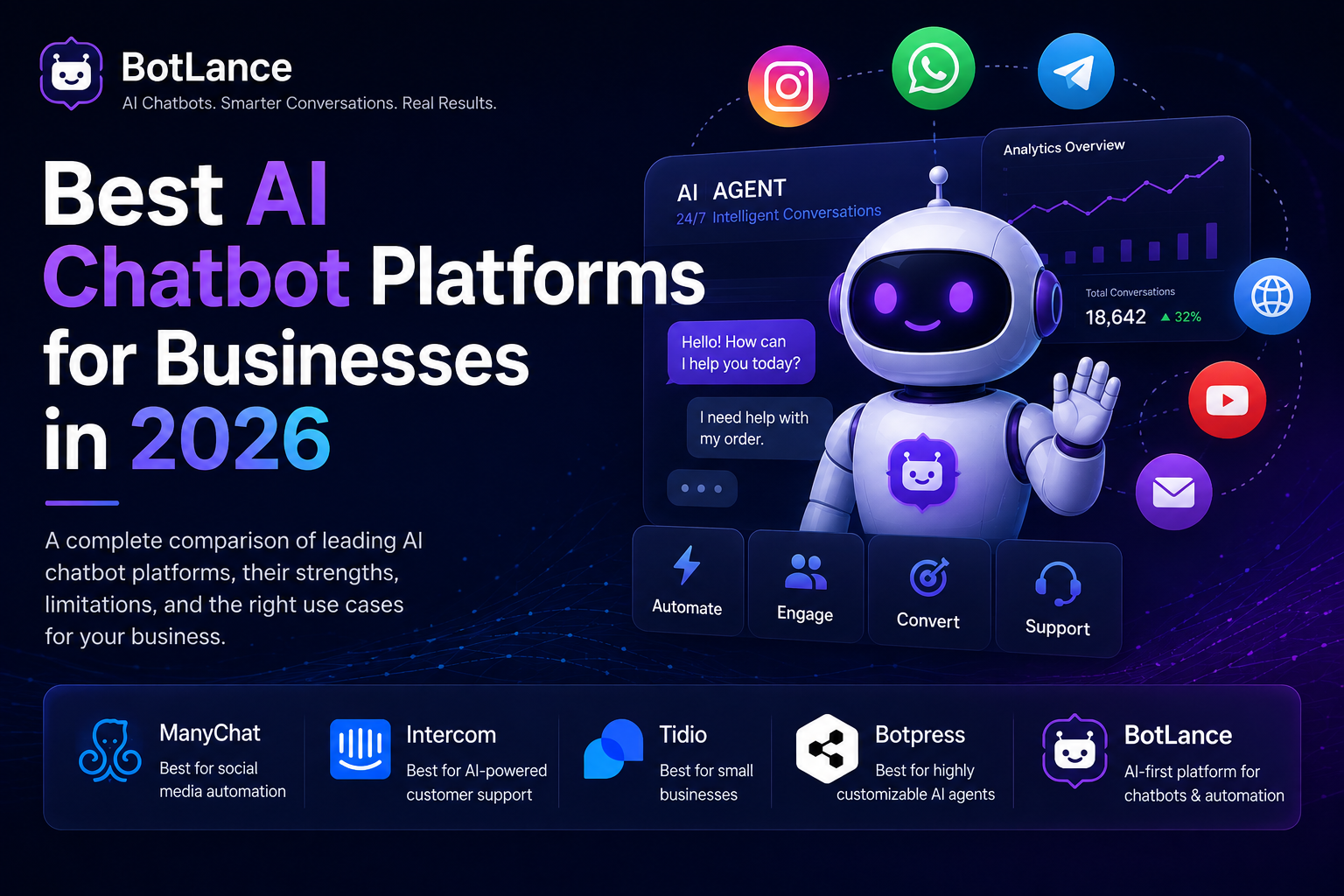
There is no single AI chatbot platform that is perfect for every business. A company that depends heavily on Instagram and WhatsApp may want a very different platform from a SaaS company looking to automate customer support, while a developer building highly customized AI agents may prefer a completely different approach. That is why this comparison focuses on five platforms with different strengths: ManyChat, Intercom, Tidio, Botpress, and BotLance. Rather than simply declaring one platform the winner, the goal is to understand what each platform does particularly well, where its limitations or trade-offs appear, and where BotLance fits into the market.
Intercom: Best for AI-Powered Customer Support
Intercom approaches the problem from another direction. Its platform is built around customer service, support teams, conversations, inboxes, help centers, and increasingly sophisticated AI agents. Its Fin AI Agent can operate across channels including Intercom Messenger, email, phone, WhatsApp, Facebook Messenger, Instagram, SMS, and Slack, depending on the configuration. Intercom also allows Fin to take actions through configured procedures and hand conversations to human agents when necessary.
This makes Intercom particularly strong for businesses where customer support is the main reason for adopting AI. Instead of thinking of the chatbot as an isolated widget, Intercom treats AI as part of a complete customer-service environment. The platform combines the AI agent with an inbox, help center, reporting, team collaboration, tickets, knowledge management, and other support functionality. That maturity is a major advantage for established support organizations that need more than a chatbot.
Intercom has also moved further toward outcome-based AI. Its current Fin pricing charges $0.99 per outcome for several types of successful AI outcomes, including resolutions, procedure handoffs, and certain qualification outcomes, while the broader Intercom platform also has seat-based pricing. The exact cost therefore depends not only on how many people use the platform but also on how much AI and channel usage the business generates.
The main trade-off is therefore not that Intercom lacks capability; it has a great deal of capability. The question is whether a business actually needs a full customer-service platform around its AI. For a support-heavy SaaS company or an established customer-service operation, Intercom can be a very compelling choice. For a smaller business that primarily wants an AI-first chatbot and automation platform without adopting a broader support infrastructure, it may be more platform than necessary, and its seat-plus-usage pricing model can also make costs more complex to predict as usage grows.
Tidio: Best for Small and Growing Businesses
Tidio takes a more approachable customer-communication approach. Its platform combines live chat, ticketing, automation, and Lyro, its conversational AI agent. Lyro can use business knowledge to answer customer questions, perform recurring tasks, support human handoff, and work alongside the company's human support team. Tidio also provides Flows for visual automation and conversion-oriented customer journeys.
One of Tidio's strengths is accessibility. A smaller business can start with a relatively simple customer-support setup and gradually add AI and automation as its needs grow. Its current plans range from a free option through paid plans for larger requirements, while Lyro is available as an AI agent product with usage limits and additional pricing depending on the amount of AI conversations required.
Tidio is also moving beyond simple FAQ automation. Its current Lyro offering includes actions, knowledge-based responses, human handoff, product recommendations, guidance, and integrations such as Lyro Connect. This makes it considerably more capable than the traditional rule-based chatbot model.
The trade-off is that Tidio remains strongly centered around customer communication and support. That is useful if your main goal is to improve website conversations, support requests, and sales interactions, but businesses looking for a broader AI operating layer across many different workflows may require more flexibility than a customer-support-focused platform is designed to provide. Tidio can be a strong choice for a small or medium-sized business that wants a relatively straightforward way to combine human support and AI, while businesses with more complex AI automation requirements may want to look at more customizable platforms.
Botpress: Best for Highly Customizable AI Agents
Botpress is a different type of competitor. Rather than focusing primarily on social-media marketing or traditional customer support, Botpress is built around creating and customizing AI agents. Its architecture gives developers and technically capable teams considerable control over how an agent behaves, how workflows are structured, and how custom logic is implemented.
The platform uses workflows and nodes to organize agent behavior, allowing businesses to build reusable sequences of logic and move between different workflows depending on the situation. Botpress also provides specialized agents for capabilities such as knowledge retrieval, policy enforcement, translation, summaries, analytics, vision, and human intervention.
Another significant strength is its support for custom code. Botpress documentation states that developers can use JavaScript or TypeScript in several parts of Studio, including actions, Execute Code cards, and hooks. This allows developers to perform data manipulation, make API calls, and implement custom business logic directly inside the bot environment.
That flexibility is valuable, particularly for teams that want to build something highly customized rather than simply configure an existing customer-service product. The trade-off is that the same flexibility can make the platform more appropriate for developers and teams comfortable designing AI systems than for businesses that simply want to switch on an AI chatbot and immediately begin managing customer conversations.
Botpress therefore occupies an important position in the market. It is a strong choice when customization and developer control are the priority. The question for a business is whether it wants to build and configure an AI-agent environment at that level or whether it wants a more business-oriented platform where AI, channels, workflows, inboxes, integrations, and operational tools are brought together in a more unified product.
BotLance: An AI-First Approach to Chatbots and Automation
BotLance takes a different approach from the platforms above. The central idea is not simply to add AI to an existing automation or support product. AI is the foundation of the platform, while workflows, actions, channels, integrations, inbox functionality, and automation are built around that AI layer.
That distinction becomes important when looking at what businesses actually want their AI to do. A modern business chatbot should not necessarily stop after answering a question. Depending on the workflow and permissions given to it, the AI may need to collect information, qualify a lead, perform calculations, call an API, trigger a webhook, use a connected service, share media, schedule something, transfer a conversation to a human, or continue a multi-step workflow. BotLance is designed around this broader model rather than treating AI as simply another step inside a conventional automation builder.
BotLance's website AI is also designed to go beyond a basic FAQ widget. The platform supports knowledge-based conversations, lead capture, human takeover, image understanding, voice understanding, live inbox functionality, and other AI capabilities, with higher plans providing additional AI-agent and workspace capabilities.
One of BotLance's more important distinctions is that it can operate as both a platform and an AI backend. A business does not necessarily have to abandon an automation platform it already uses. For example, a company can continue using a platform such as ManyChat or GoHighLevel for a particular channel or automation workflow and send the customer's input to BotLance through an API, webhook, or external request. BotLance can then generate the AI response and return it to the external system, which delivers the response to the customer. In this model, BotLance becomes the AI intelligence layer behind an existing automation system rather than forcing the business to replace that system.
This creates a useful distinction for businesses that already have a significant automation setup. Someone using ManyChat for Messenger, TikTok, Instagram, or another supported channel can potentially keep ManyChat responsible for that channel and use BotLance as the AI backend. The same architectural idea can be applied to other API- and webhook-capable platforms. The purpose is not to claim that those platforms lack APIs; quite the opposite. Their APIs and external-request capabilities make this type of integration possible.
BotLance also provides native channel integrations of its own. Its current platform includes website, Instagram, WhatsApp, Telegram, YouTube, and email capabilities, while voice AI is another part of the platform's broader AI functionality. Messenger and TikTok should not be described as native BotLance channels; when those channels are involved through an external platform, the external platform remains responsible for the channel while BotLance can provide the AI layer behind it.
Another area where BotLance aims to go beyond conventional automation is workflow logic. The platform includes a JavaScript Node that can be used inside workflows for advanced calculations, scoring, data processing, and custom logic. This means a workflow does not necessarily have to stop and send a calculation to another external automation service simply because the logic becomes more sophisticated. The business can perform that logic inside the workflow itself. This capability is currently part of the product even though its public documentation is still being expanded.
BotLance also includes AI Actions and HTTP/API capabilities that allow workflows and AI agents to communicate with external systems. This is particularly important because the value of an AI agent often depends on what it can do after understanding the user's request. An AI agent that can retrieve information or trigger a business action can be significantly more useful than one that can only generate a conversational response.
The same principle applies to media and real-time interactions. BotLance's media capabilities allow an agent to work with media as part of a conversation rather than treating the chatbot as a text-only interface. Combined with voice understanding, image understanding, AI actions, workflows, and human takeover, the objective is to create an AI system that can participate in a much wider range of customer interactions.
BotLance's Instagram capabilities also illustrate the difference in approach. ManyChat has strong Instagram automation and currently supports AI-powered conversations, comments, and other social engagement functionality. BotLance, however, approaches Instagram from an AI-first workflow model, allowing AI behavior to be combined with workflow logic and other platform capabilities rather than limiting the AI experience to a narrow social automation feature.
This does not mean BotLance is automatically better for every Instagram marketer. ManyChat has years of experience in social automation and a large ecosystem, and businesses that primarily need established social-media automation may reasonably prefer it. The difference is that BotLance is attempting to solve a broader problem: how to put AI at the center of customer conversations and then connect that AI to workflows, actions, business systems, and multiple channels.
BotLance vs. the Alternatives: Which One Makes Sense?
The right choice depends heavily on what the business is actually trying to accomplish. ManyChat is a natural choice for social-first businesses that need powerful messaging automation, broadcasts, comment triggers, and social engagement workflows. Its current platform covers a wide range of channels and combines those capabilities with AI-powered conversations, making it particularly attractive to creators, marketers, agencies, and businesses that live inside social media.
Intercom makes more sense when customer support is the center of the operation. Its combination of Fin AI Agent, inbox, help center, reporting, tickets, team collaboration, and multiple support channels creates a mature environment for businesses that need structured customer-service operations. The trade-off is that this broader infrastructure comes with a more complex pricing and product model.
Tidio is attractive for businesses that want a more accessible combination of live chat, automation, and AI customer support. Its Lyro agent and Flows can handle a meaningful amount of customer communication without requiring the business to build an extremely complex AI system.
Botpress is particularly compelling when customization and developer control matter most. Its workflow architecture, agents, and JavaScript/TypeScript capabilities give technically capable teams a great deal of flexibility. The trade-off is that greater flexibility can also mean greater responsibility for designing and maintaining the system.
BotLance is most interesting for businesses that want AI itself to be the central layer. It combines AI chatbots and agents with workflows, actions, integrations, inbox functionality, voice and image capabilities, native channels, and the ability to operate as an AI backend behind other automation platforms. That makes it possible to use BotLance directly for supported channels or connect it behind an existing automation system when replacing that system is not the goal.
So, Which AI Chatbot Platform Is Best in 2026?
There is no universal winner. The best AI chatbot platform is the one that matches the way a business actually operates.
If your business is heavily focused on Instagram, WhatsApp, Messenger, TikTok, and social-media automation, ManyChat is one of the strongest choices to consider. If your primary challenge is customer support at scale, Intercom's combination of Fin and its broader support infrastructure is difficult to ignore. If you want accessible AI-powered customer communication for a smaller or growing business, Tidio is worth considering. If you have developers and want deep control over how your AI agents work, Botpress provides a powerful foundation.
If, however, your goal is to put AI at the center of the customer experience while still having workflows, actions, integrations, inbox functionality, voice and image capabilities, multiple native channels, and the ability to connect AI behind other platforms through APIs and webhooks, BotLance deserves a place on the shortlist.
The most important thing is not choosing the platform with the longest feature list. It is choosing the platform that fits the job. AI chatbots are becoming increasingly capable, but businesses should look beyond the word "AI" and ask a more practical question: what can this system actually do once a customer starts a conversation?
That is ultimately where the next generation of business AI is heading. The chatbot is no longer just a box that answers questions. It is becoming a layer that understands customers, works with business systems, follows workflows, performs actions, and helps move conversations toward real outcomes.